
How to Find Recently Released Washington County Inmates
The Sheriff's Office keeps a recent-custody page that shows bookings and releases from the last few days. Read it alongside the current roster, because a person moves from current custody to released status once bond, a court order, a sentence end, or a transfer takes effect. If a name is on the current roster, the person is still in. If the name is gone and shows on the recent list, a release or transfer likely happened.
Start with a name. Then move through the sources in order.
- Check the current detainee roster first.
- Open the Sheriff's recent custody and release list.
- Check the court case for a release or bond order.
- Search state custody if the person was sentenced to prison.
- Register for alerts so you learn of the next change.
The recent list links from the Sheriff's detention information section. For the live custody view, the inmate records page covers the full roster.
Setting Up Release Notifications
You do not have to keep refreshing a roster. VINELink is a free custody-notification service that can alert you when a custody status changes. You select the state, search for the person by name or ID, and register a phone number, email, or PIN for alerts. It is the simplest way to learn of a release without checking the page every day.
| Field Label | Type | Required | Notes / Format |
|---|---|---|---|
| State | Dropdown / search | Yes | Select Arkansas. |
| Name / ID | Text | Yes | Offender or inmate name or ID. |
| Agency / facility | Filter | No | Narrows the custody source. |
| Notification registration | Form | No | Phone, email, or PIN for alerts. |
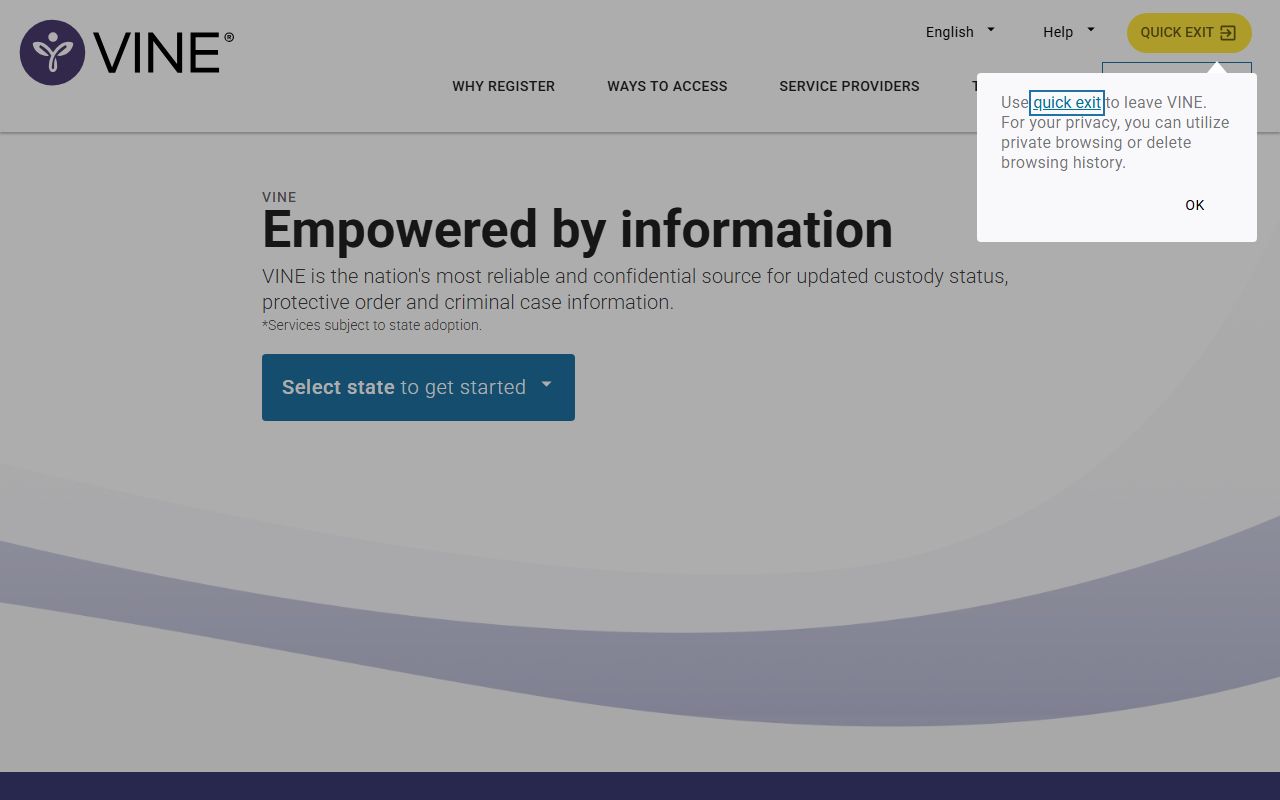
The VINELink search page above is where you register for alerts. Open it at VINELink. Alerts depend on the custody source supporting the service. Victims and concerned family members use it most, because it removes the guesswork of checking a roster by hand. Once you register, the service contacts you when the status changes, so you learn of a transfer or release without watching the page. Keep your contact details current so the alert reaches you.
Searching State and Federal Released Inmates
When a person leaves the county jail for prison, the search moves to the state. The Arkansas Division of Correction inmate search covers sentenced state inmates, and the Arkansas Community Correction offender search covers people on state supervision. For federal custody, the Bureau of Prisons locator is the tool. Each one is free. The DOC search works best with an ADC number, but a name search works too.
| Field Label | Type | Required | Notes / Format |
|---|---|---|---|
| ADC number | Text | No | Best exact identifier if known. |
| Last name | Text | No | Name search. |
| First name | Text | No | Narrows a name search. |
| Gender / race | Dropdown | No | If exposed by the page. |
| Facility / status | Dropdown | No | If exposed by the page. |
The federal locator searches by register number or by name, with race, sex, and age filters. Open the Arkansas Division of Correction inmate search, the Community Correction offender search, or the Federal Bureau of Prisons locator.
A state inmate record commonly shows the ADC number, name, facility, status, and sentence basics. Use it to confirm whether a person is still in state custody or has been released or paroled. The split matters because the county jail and the state prison are different systems. Someone who finishes a county case may still face a state sentence, and someone who leaves the county roster may simply have moved up to a state facility. Checking both keeps you from drawing the wrong conclusion from a single empty result.
How Releases Happen
People leave the Washington County Detention Center for several reasons, and the reason shapes where you confirm it. A bond release happens when someone posts the amount the court set, through cash, a surety company, or a property bond. A court-ordered release happens when a judge orders it, such as a release on recognizance or a dismissal. A sentence completion ends a short county term. A transfer moves a person to a state prison or another county, which can look like a release on the county roster even though the person is still in custody elsewhere.
Because of that last case, a missing name is not proof of freedom. Pair the recent-release page with the court case and, where it applies, the state inmate search. The court record may carry a release order or a bond disposition that explains exactly why the person left county custody. Reading the reason matters, since a release on bond is very different from a sentence that has been fully served, even though both remove a name from the current roster.
Verifying Release in Person or by Phone
For urgent situations, do not rely on a web page alone. Online lists update on a schedule, so a release may post hours after it happens. Call the jail's detention information line to confirm a current custody status. A release date shown on a public page is not a certified court disposition, so pair it with the court case if you need proof.
If safety is a concern, registering for VINELink alerts is the steadier path, because the alert reaches you the moment the system records the change. The court case can also show a release order or a bond disposition that explains why someone left custody.
The Sex Offender Registry
Some people want to check the public registry after a release. Arkansas runs a statewide sex offender registry through the Arkansas Crime Information Center. You can search it by name, by address, or by county, and narrow by distance where the tool offers it. It is a public-safety lookup, separate from the jail roster and the court case.
| Field Label | Type | Required | Notes / Format |
|---|---|---|---|
| Name | Text | No | Search a registrant by name. |
| Address / city / ZIP | Text | No | Geographic search. |
| County | Dropdown | No | Select Washington County. |
| Radius | Dropdown | No | Distance from an address, if offered. |
Open the Arkansas sex offender registry to run a search near a Washington County address. Registration obligations sit in Ark. Code Ann. § 12-12-901 et seq.
Parole and Probation Information
Release from custody often comes with supervision. Parole is supervised release from prison. Probation is supervised release ordered by the court, often instead of or after jail time. People on state supervision can appear in the Community Correction offender search. A supervision status can carry conditions like reporting, testing, and travel limits, and a violation can send a person back to court or custody.
For the court orders behind a supervision term, the court records page and Search ARCourts show the case. A probation warrant, if one issues, would appear on the warrant records page. Supervision is not the same as a clean discharge. A person can be out of custody yet still under conditions, and those conditions stay in force until the term ends or a judge changes them. That status can matter for housing, travel, and the timing of any record-sealing request.
Reentry Resources in Washington County
Leaving custody is the start of a hard transition, and several resources help. Arkansas Community Correction supports supervision and reentry. Civil legal needs like housing, benefits, and family matters can run through statewide legal aid. Workforce and nonprofit programs help with jobs, ID, and treatment. The list points to starting places.
- Arkansas Community Correction - supervision and reentry support.
- Arkansas Access to Justice - civil legal help and self-help resources.
- Arkansas court forms - including sealing and fee-waiver forms.
- Local workforce, treatment, and nonprofit programs in the Fayetteville area.
For the legal side of a fresh start, sealing a qualifying record can ease housing and job searches. The arrest records page covers the sealing process. Because Washington County sits in the fast-growing Fayetteville and Springdale area, demand for these services runs high, so it helps to reach out early rather than wait for a crisis.
Civil Rights Restoration After Release
A release does not restore every right at once. In Arkansas, voting rights after a felony conviction generally return once a person finishes the sentence, including any imprisonment, parole or probation, and required costs or restitution, as set by law. Until then, registration eligibility is not restored. Firearm rights are a separate matter and often need a pardon or a formal restoration. Sealing a record does not automatically restore firearm rights.
Because the rules turn on the offense, the sentence, and the paperwork, anyone restoring rights should confirm their exact status before they register to vote or possess a firearm. Legal aid and the court can help sort it out.
Note: A public release date is not a certified court record, so verify custody and rights status with the responsible office before relying on it.
Property and Paperwork After Release
A release is not always instant. After a court orders it or bond is posted, the jail still has to process the paperwork, return personal property, and arrange the person's departure. That can take time, especially during busy hours or when a hold or another warrant surfaces during processing. So a bond posted at noon does not always mean a release by one o'clock.
If a person had a hold from another agency, that hold has to clear before release. This is one reason a roster can still show someone after bond is paid. Patience and a phone call to the detention information line usually answer the "why are they still listed" question better than refreshing the page.